This blog is on overload! To find more of Charles' essays, please visit:
Muck Rack:
https://muckrack.com/charlesekraus
Medium: https://ctmagician.medium.com/
This blog is on overload! To find more of Charles' essays, please visit:
Muck Rack:
https://muckrack.com/charlesekraus
Medium: https://ctmagician.medium.com/


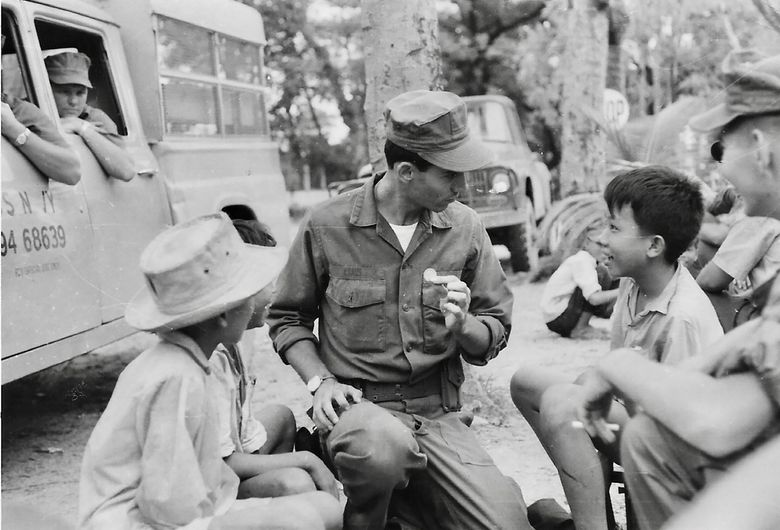
One day I’m in the mud and muck of a monsoon. Our unit is informed we have an hour to gather personals, hand over M16s to the armorer and muster by the administrative hut. We are driven onto the Chu Lai airstrip where a Braniff passenger plane, complete with miniskirted stewardesses, arrives to take us back to the States. It’s the only commercial aircraft I’ve seen in Vietnam. Also the only miniskirts. We breakfasted while refueling in Alaska, then flew on to Rhode Island and our stateside base. The next day, I’m reading the Sunday newspapers as the train pulls into Grand Central. The real warriors suffered from PTSD. I was happy to settle for culture shock.
This is National Vietnam War Veterans Day, marking 50 years since the last U.S. combat troops left Vietnam. These days, people send notes of appreciation, come up to me and say, “thank you for your service,” They use terms such as “hero,” and “warrior.” I was neither. Nor were most of my uniformed buddies. Lots of the folks doing the appreciating weren’t born when my cohort was stationed in South Vietnam. At the time, Americans held mixed opinions about U.S. involvement in Southeast Asia. I was called a lot of things by the opponents of our escalating war effort, none of the terminology praised my personal attributes.
I spent the war zone part of my enlistment attached to MCB 71, a Naval Construction Battalion. CBs were basically builders. Others did the destroying, we maintained the airstrip and the roads.
Our home base was Davisville, R.I. You could board the train and ride from Providence to Manhattan in a few hours. Suggestion, word passed, unofficial, but a serious consideration, best not to wear your uniform off base. Protesters and the like. When I’d meet up with civilian friends. I had the shortest hair in the crowd.
There were many ways to experience the war.
One involved handling administrative tasks in relatively safe territory, well below the Demilitarized Zone. Another featured the boonies, haunted terrain filled with nasty potential. A supply petty officer, spending most of my days issuing replacement parts, I hurt my ankle jumping for cover. That was the only injury I sustained in-country. My cousin miraculously survived being blown just about to bits by an IED. He’d been assigned to the boonies
Stateside, fathers vs. sons, protesters, draft resisters, patriots and hardliners, staged competing actions, flag burnings, civil disobedience and parades. Our government offered endless claims that victory was just around the light at the end of the corner. The corner turned out to be downstream, at the far end of an ever telescoping tunnel.
A walk through Davisville could get enlisted men free donuts and coffee courtesy of the Salvation Army, or entrance to the YMCA’s military facilities. Here, you might see notes inviting soldiers and sailors to dine with local families. A friend of mine took up an offer and spent a turkey dinner listening to his hosts trying to talk him into deserting. They’d help him get to Canada, right then and there. He declined.
I knew a recruit who had legitimate second thoughts about participating in the conflict. A storefront anti-war counseling service assured him he could apply for and receive Conscientious Objector status. Just look up the regulations. Follow the procedures. Only the regulations were mysteriously missing from the various sets of Uniform Regulations binders that he consulted. The counselors pressed him to no avail. The advice my buddy had received came from naïve sloganeers. You could find them on both sides of the equation — people who had strong opinions based on sketchy information.
Being in the middle of a war zone taught me little or nothing about the war’s historical context, the politics that had gotten us into combat, or even our military strategy. What I took away was that with few exceptions, the people with whom I worked — war is a job — were decent young men from modest backgrounds with uncertain prospects. Being in uniform was where fate, not patriotism, had landed them. They had few long-term goals. Life was dealt with on a minute to minute basis.
Half a million of us participated. More than 50,000 American military personnel perished. Several million Vietnamese, civilians and military, died. Since my discharge in 1970, while continuing my education and winding my way through the decades, I’ve encountered very few people who fought in Vietnam. We were not a cross-section. We were a particular set of individuals, called upon to actualize the objectives of those who claimed to know best.
Kraus was awarded the Bronze Star. He is the author of “You’ll Never Work Again In Teaneck, N.J.,” a memoir.

 Professional caregivers come for 16 hours a week. For the other 152 hours, ensuring the safety and wellbeing of my ailing wife is my job.NITO/ADOBE
My wife and I have been married for over 50 years. She is not all that well.
She’s been through four, count ’em, four hip replacements, two back surgeries, a new knee — 10 major operations in the past 20 years. She is dealing with arthritis, sleeping issues, and a certain amount of trouble remembering. Side note: Mechanically speaking, both of our hearts are past warranty.
My merely sufficient caregiving skills lose their credibility as the day drags on. I tire. Get frustrated. Upset with circumstances. Some problems do not appear to have solutions. I relegate my own needs and interests, their urgency lessened, tempered by the part of me that cannot commit to them because I’m “on alert.” Might be beckoned. Should be checking. You OK? You take your meds? Where is your walker?
My wife falls. Often. I’m in the other room, or standing right next to her. One minute she’s vertical, the next she’s sprawled on the kitchen floor. We are going to look at wheelchairs as soon as we receive the prescription from her doctor. But for now, the physical therapist has “taught” her how to right herself. To crawl to a chair or the edge of the bed and work her way up.
I assist, coach, am ready to call someone. Did you hit your head? Do you need to see a doctor?
[more below]
You ever visit the ER in the middle of the night? Get your wife into the car, sit in the waiting room along with throngs of others who are competing for medical attention. You listen for her name, eventually called, only to be told things are OK, or OK enough, and that she should contact her physician in the morning. What was more dangerous: the fall or venturing out in the night?
Amazingly — perhaps due to a dozen or so medications, physical therapy, counseling, caring doctors, kind and loving input from our children, intermittent visits from home health caregivers — most of the time my wife functions well, comes across as her smart, personable, responsible, “normal” self. Unfortunately, the on/off switch operates by its own illogic, thrusting her from self-contained to in-need-of-assistance with random regularity.
Professional caregivers step in when there are things that need doing. Light housekeeping is part of the job description. Meal prep. Helping with showers, drives to medical appointments, and various assorted tasks of living. The agency sends associates twice a week for eight hours at a clip. We could ask for more. We may. But selfishly, we enjoy our privacy.
How would you feel having caregivers — nice people, but basically strangers — inhabiting your home, waiting for something to do while you try to go about your quasi-independent life? I believe the assignment requires someone else to cover the other 150+ hours of each week. I’m that person.
Caregiving is often a standby activity, a from-time-to-time and throughout-the-course-of-the-
We use tools. The walker. The cellphone whenever we are apart. The pendant — a necklace with a panic button that, if pressed, triggers a Wi-Fi network to alert emergency personnel somewhere in the Midwest who respond via a dedicated intercom. “Hello, are you OK? Should we call 911?” Having the system is reassuring, but I wonder what would happen if my wife took a serious spill and was unable to press the button. Still, I make sure she is wearing her necklace when I am out of the house.
Living a long life requires adjusting over time. Downsizing expectations. And sometimes, just as you were hoping for a little less to do, for a graceful meander into fewer obligations, you realize that reality is not scripted by Hallmark.
Charles E. Kraus is the author of “You’ll Never Work Again In Teaneck, N.J.”

Doing your own writing offers a certain pride of ownership that AI cannot match: Charles E. Kraus
Published: Feb. 15, 2023, 5:45 a.m.
By Guest columnist Charles Kraus
SEATTLE -- I love writing. As far as I’m concerned it is the best game, the most engaging puzzle, and one of the more rewarding activities that I get to experience. It is being in the moment for hours at a time. I work on a paragraph, section, chapter, look up and find that afternoons have passed. And at some point, when I’ve shaped my thoughts and am ready to send them into the world, I feel a sense of accomplishment.
Take a deep breath, Charles, and walk off the field knowing you’ve used your skills, engaged your mind, functioned at capacity.
As you may have guessed, I’m not a fan of AI writing software. Artificial intelligence is a short cut that can be valuable if you are in a hurry, but that depersonalizes the finished product and cheats you out of the pride of ownership that comes from being a ‘do it yourself’ writer.
“Oh my.”
That’s me reacting to what I put into words. Me reflecting on the way I organize my thoughts then total them into summation. Suddenly I realize how I feel about the topic at hand.
During my student days, the scribbles I put on paper mirrored the authors I happened to be reading. And like most beginners, my efforts yielded meager results. Turned out, I wasn’t Kerouac, or Salinger. And S.J. Perelman needn’t worry about my taking his place at the New Yorker.
Over time, all the styles and approaches I tried out merged into a version that offered more of me and less of those I’d been emulating.
Early on, I benefited from a certain amount of guidance. To this day, when editing a first draft, I hear my late father’s voice going over the material. Asking me to find a better word, to improve a convoluted sentence. To clarify. To write tight. This process offers two benefits, an improved draft, and the pleasure of yet again working on a project with my dad.
One of my first attempts at an extended piece of writing was a 97 page “novel” that I concocted when I was about fifteen.
My handwriting was atrocious, even then. And my misspellings barely reached the phonetic equivalent of any known language. The entire effort was a juvenile homage to J.D. Salinger. I mentioned the manuscript to my English teacher, a wonderful, supportive man who asked to see it. Then held on to it for several weeks.
When finally returned, I found that he’d gone through my entire text, correcting spelling, suggesting changes, praising a passage or two, and more than anything else, giving me the sense that what I had put on paper was worth my effort and worth the time he’d spent editing.
I got a little older and life took me away from home. It turned out I was quite the correspondent.
This was before computers; before the internet. I’d draft a letter. Type it up for friend No. 1. Retype it with minor changes for friend No. 2, repeating this process -- typing, adjusting, generally improving, each version so that by the time I’d pounded out copy No. 20, the contents had been perfected.
There are many ways to improve your writing. I don’t necessarily recommend this one. Just write until you’ve done your best.
The results will be YOUR best. They’ll speak to a certain pride of ownership.
AI is lawn mowing. Writing it yourself is gardening.
Charles E. Kraus is the author of “You’ll Never Work Again In Teaneck, N.J.” He writes from Seattle.

In a convoluted way, I spent my time in Vietnam and in other duty stations so that we could hold an election on November 8th. With this in mind I'm half thinking I wasted my tour.
There are many reasons men and women enlist. Some of mine were altruistic, but I can see that joining the armed forces had to do with defending a way of life.
Wearing the uniform meant I believed in everyday freedom. That our country offered enough peace and stability so that we simply went about our lives using reason to guide our actions. That laws and customs mirrored rational behavior. True, there were tensions. Discrimination and antisemitism were (and remain) pressing issues. But people got along well enough to maintain a calm, generally courteous or at least orderly demeanor in the public square.
They tamed or channeled their political doubts into the election process, assumed stability and went about their lives, expressing opinions when it felt appropriate to do so.
I was defending some other things, too.
Accumulated knowledge, for one. The concept that intelligent individuals and institutions of higher education were taking the time to examine the past and think about the future. That science and history and philosophy were real. Genuine. Worthy of respect. Necessary. Helpful.
That credibility was earned. Opinions were not facts. And though people were entitled to believe whatever they wanted, some opinions, those backed by evidence, by a consensus of the learned, the experienced, the seasoned, were generally more valuable and useful than those held by mere mob sloganeering. By know nothings who spouted the latest peer group mantras.
I was defending the long haul. A positive arc. Progress that saw my grandmother and her cohort benefit from Social Security. Without realizing it, I was helping to sustain the Food and Drug Administration -- uncontaminated food and water. The Public Health Service - I knew some kids with polio and felt the enthusiasm and relief of the community, of the entire country, when the vaccines were administered.
As a child our family regularly traveled south from New York into overt segregation. The separate bathrooms and water fountains in railroad stations that mandated color conscious waiting areas. The failures and successes of the NAACP, CORE, Southern Christian Leadership Conference, the Student Nonviolent Coordinating Committee. The marches, the riots. The Kennedy assignation and the orderly transfer of power. All of this was part of contemporary history when I walked into the recruiting center and signed up for military service.
Resistance and progress; the opening up of society. An array of life styles and cultures. The energized and more accepting patchwork of neighborhoods and individuals expanding over time.
I recall that Times Square was more than the heart of Broadway. I'd regularly passed demonstrations against nuclear weapons testing. Later saw test bands enacted. The country looked and felt as if it was becoming a safer place. Back then. When I put on the uniform.
The individuals who protested weapons of destruction were part of a group calling itself The Committee for a SANE Nuclear Policy (SANE). They wanted what we all seemed to want, a safer, saner world. That was then. Now feels like an unraveling. A miscalculation.
I just sent in my ballot so I guess a glimmer of hope remains deep within. Feels kind of lonely.
////
Charles is the author of Baffled Again and Again. He was awarded the Bronze Star.

By Charles Kraus
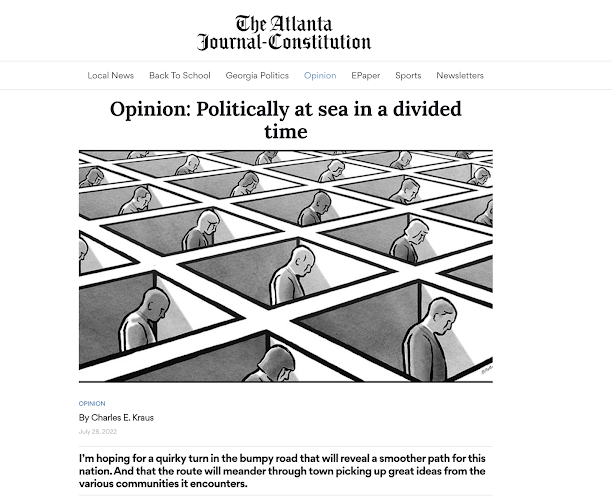
Sages: Rachel is back. Tucker is unvaccinated. Jen Psaki is moving on. Jeffrey Toobin is keeping his hands on the table. Who guides us as we stumble forward trying to survive the cumulative effects of the past?
As newborns, we are handed a packet of assumptions that we spend our lives scrutinizing. Our parent's beliefs, our community's norms, social and religious canons. It is assumed we will feel, think and live these hand me downs. Find them to be accurate pictures of reality. Rock solid doctrine.
Some of us have doubts.
Though my father never explicitly stated so, his motto was, always believe everything you read as long as it supports your point of view. I took a look at that when I was about twelve and thought I'd try another approach. One thing I found was that seeking truth was an aspirational goal.
I tend to favor mainstream points of view, the established scientific and historical pronouncements. Who am I to question the experts? I sign on, but with a caveat, a realization that lending support to such opinions is like making purchases from Costco. I can take things back or exchange them whenever I want to. I am, after all, espousing other people’s educated guesses, tainted with unavoidable bias and the limits of knowledge in its current state.
Religious and political charlatans build careers and movements by working persuasion and emotion. Genuine experts, on the other hand, are well versed in facts and context. What they know didn't arrive on carts of ethereal revelation. Knowledge is verifiable, accruing and interlocking. Though, of course, I keep in mind that each side in a lawsuit calls experts to the witness stand, and we get second opinions from doctors because medical diagnosis and treatment plans are not always formulaic.
These days, most movers and shakers have resumes. Bona fides. Certificates of graduation. An informal biographical survey of contemporary authority brings up a handful of alma maters. Stanford, Yale, and Harvard seem to have influenced more critical thinking than the King James Bible. Do the names Elon Musk, Larry Page, Bill Gates, ring a bell? How about Hillary Clinton, George W.H.. Bush, Paul Krugman, John F. Kennedy, and Michael Bloomberg? Once upon a time they were matriculated at these universities. And just to complicate matters, I'll throw in Ron DeSantiss, Ted Cruz, and Peter Thiel, gradates from Harvard and Stanford. People show up at the library with a notion of the books they want to borrow. We are not all working from the same syllabus. Perhaps there is a difference between profound wisdom and grade point average.
I pick and choose my sages by their well reasoned arguments, and the caliber of their endorsements. Folks who resort to outrage, to rhetorical gamesmanship, name calling, denials of reality, who are more interested in rights than responsibilities, can leave the room by the back door, please. I'm not interested in watching them conflate temper tantrums with persuasive arguments.
My kids attended a school where the philosophy for conducting one's self boiled down to a motto: Curtsy and Common Sense. I wish I'd gone to that school. I wish all of us had.
The Uncover Up
By Charles E. Kraus
They gathered on the steps of the Lincoln Memorial. I thought about it.
I'm a rather average member of my community. Not particularly well off. More self educated than formally educated. Family man. I like that last description best. I vote. Try to do my share. Attempt to be empathetic. But, I believe I'm running out of empathy. The world is just too exasperating, and I'm overcome by displeasure. The final straws are Covid related, Not Covid itself. If I can put my hand on any one culprit, I'd say it is Covid-ignorance. I'm thinking about those who react foolishly and selfishly to this contagious, sometimes deadly, disease.
So many people who I talk with are tired of excusing anti-vaxxers. Is it that difficult to be sensible? Poor, confused, misled, undereducated, well meaning souls that have gone astray -- that’s one way to look at them. In the alternative — uncaring, irresponsible, illogical, unneighborly folks, disinterested in reality and willing to gamble with their own lives and the lives of others on the erroneous theory that science is junk.
Wearing a mask is too uncomfortable? That uncomfortable? Every three year old I see walking down the street with mom has managed to overcome the awkwardness. Do you find using an NR95 so demeaning you'd rather reveal your nose than help protect mankind? Let me tell you, I've seen your nose, and keeping it covered enhances your profile.
Social Philosopher Eric Hoffer’s book, 'The True Believer,’ published in 1951, describes the psychological roots of fanatical groups. The benefits bestowed on membership include a sense of power that comes from being obsessed and disruptive. True Believers don’t need facts, they need causes. Facts are mundane, nuanced, boring. Causes are exciting. Putting a thumb in society’s eye can finally make life meaningful.
Perhaps you are one of those independent anti--vaxxers whose developed concerns about how Bill Gates plans to use the vaccine's secret infinitesimal microchips to send subliminal messages to your subconscious. Conspiratorial little whispers. "Choose sanity." That kind of thing. It's a moot point. Back off. Gates has recently removed the chips from Pfizer and Moderna, and is now hiding them in Hershey chocolate bars. You thought those were almonds?
To unmask the unmasks, I'll tell you their dirty little secret. They believe in post-covid medical intervention. Why else would deniers head to the hospital AFTER they contract Covid? Evidently, deep down, they know and have known all along that science is their best bet. They're just parsing the particulars.
People have to work hard to ignore natural survival instincts. Spotting a runaway truck headed in your direction sends you into a fight or flight response (in this case, I'd suggest flight). Spot a virus heading in your direction -- well, you know what you are supposed to do. Take precautions. Look over possible responses and choose those that seem to have the best odds. Bravado is not one of them.
What you are not supposed to do is pretend your intuition outweighs reason.
By Charles E. Kraus
Mort Sahl has died.
I own all the records, even the very early At Sunset album famous for being the first Mort Sahl recording and because Fantasy Records increased the speed so they could fit the entire concert onto two sides of an LP (Fantasy Records Mono 7005 Red Vinyl Deep Groove), Mort sounds like a perceptive Mickey Mouse on Benzedrine.
My collection began in 1959. A few years later, I was a kid in a boarding school with the Verve and Reprise records in my closet. The rule was, doors open, hit the books each night from 7 until 9. Except, I had the records. My roommate and I would close our door and play them endlessly. You listened long enough and you started speaking like Mort. Took on his point of view. Did what he did, finding what you said funny and laughing at your own jokes.
Mr. Weinberger would come by. He was an old man with a drill sergeant’s voice, hired to enforce the rules. He’d open our door, step in, listen to Sahl for a while, then step back into the hall closing the door behind him. Mort Sahl was a kind of a hall pass.
Howard Liberman and I returned to the Village Gate nightclub over and over again trying to determine just how much of the routine was ad-lib, taken from the day’s newspapers and current events. That was the official story. What we discovered was that Sahl arranged and rearranged. Adjusted material. Added something, brought back an old comment in new pants. One of his talents was keeping track of what he’d used early in a set so it didn’t get repeated.
Once, a few years later, I attended a performance at the Alhambra Library in Southern California. He wasn’t working much, rumors had it he’d been blacklisted courtesy of the Kennedy clan once he’d begun doing jokes about Jack. The show took place in a basement community room. It was packed. Crammed with fans who’d been waiting for an opportunity to hear from the man. Sahl went on and on and on. Two hours, at least. More extemporaneous than not. When he was hot, the guy could really wing it. Nobody wanted to leave, not even Sahl.
My first job in broadcasting was in the script typing department at CBS’s Television City. We began in the late afternoon, once the writers had left the building, and stayed into the night, often into the early morning, typing, mimeographing, collating, and stapling scripts for All In The Family, The Carol Burnett Show and other programs produced in-house. Then our little unit would head up the street to Cantor’s Deli. Open all night, we’d arrive at 2 or 3 in the morning, and sometimes spot Mr. Sahl at a table reading the papers and taking notes.
We didn’t bother him. It would have been rude. But several years after that, Sahl and I crossed paths at a Denny’s in Sherman Oaks. I couldn’t stop myself. I have all your records, I have your book, I’ve seen you dozens of times, on Broadway, TV, in the clubs — New York, LA, Chicago, Vegas. I was just the kind of fan I knew Sahl hated; knew could upset him. But I’d picked a good moment. He shook my hand and thanked me. He wasn’t as tall as I’d imagined.
There were rough edges. He walked away from his role in Lorraine Hansberry’s play, “The Sign in Sidney Brustein’s Window.” Hosted, then left various radio and television programs under awkward circumstances. He wasn’t erratic, so much as subject to misunderstandings. That was part of the baggage and the mystique that he brought on stage if and when you were lucky enough to catch his act.
I’d played his records for my daughters, talked about him often, repeating favorite lines. “Not everything I say is true, but it’s accurate.” “The reporter said he’d never been told what to write. But he knew what to turn in.” “A conservative is someone who believes in reform. But not now.” “Liberals feel unworthy of their possessions. Conservatives feel they deserve everything they’ve stolen.”
At 77, he’d returned to New York. The Village Gate, his old stomping grounds, had become the Village Theater, and he was booked for a week. I had flown east with my kids to see a few shows. Someone else was doing a last stand in the city. Hal Holbrook presenting his Mark Twain.
Mort showed up with his blackboard routine, graphing the political stance of various members of our government. He’d updated things, switched from a blackboard to a whiteboard. Had some magnetic cutouts that he slid around. Two of his friends, Woody Allen and Dick Cavett sat directly in front of us. It was a modest crowd. But friendly and pleased with the familiar routines. Sahl wore his trademark sweater. Cavett had dandruff.
Over the years, particularly as Trump turned politician, I hoped that a Sahl comment, some bright new line, observation, insight, would surface. None materialized. But I could, I can, still hear him. “Are there any groups here I haven’t offended?”
No. And none that you haven’t entertained.
Charles E. Kraus is the author of “You’ll Never Work Again In Teaneck, NJ.”